
Historic Honoka’a
Historic Honokaʻa
Timeline on Honokaʻa Businesses and Infrastructure
1873 The Rickard family moves to Honokaʻa and live in Haina
1878 or 1880 William H. Rickard becomes manager of Honokaʻa Sugar Company
1879 George Hardy (uncle to William H. Rickard) sells piece of land (next to the Botelho graveyard) to the Catholic Church) – (first church called St. George)
1880 Directory (George Bowser) Honokaa Store, Joseph R. Mills, Proprietor, General dry goods merchant, groceries, hardware, paints, oils, etc.
1880 Directory (George Bowser) “Honokaa is quite a flourishing village. It is situated upon the road and about a mile from the sea. In its suburbs are some very nice residences. There is a Court House in the village and the wants of the neighborhood are met by the presence of half a dozen stores, a butcher’s shop and a restaurant.”
1880 Approximate date of the building of Holmes Store (later Lawson’s Department Store, Awong Store and now the Credit Union) Char and Char pg. 83
1882 William H. Rickard and others purchase land from government to build Honokaʻa Lyceum (where Honokaʻa School is now)
1883 George Willfong built the house now known as the Rickard House on Māmane Street (Olival)
1886 Queen Kapiʻolani visits Honokaʻa and is hosted by William H. Rickard – Letter from Curtis Iaukea thanking the Rickards for their hospitality
1887 William H. Rickard and others obtain land to build the Honokaʻa Lyceum in front of Honokaʻa School (musical events were held there and the band practiced there as well) – Tomich Perspectives on Hāmākua
1888 On June 26th Queen Kapiʻolani visits Honokaʻa and is escorted by Hon. Sam Parker, Major Lumaleilei, Mr. J.R. Mills and R. T. Rickard (brother of William H.) – The Hawaiian Gazette July 10, 1888
1889 The first school is built in Honokaʻa on the site now occupied by the teacher’s cottages makai of Mamane Street – Bets Lawrence’s A History of Honokaʻa School (1993)
1889 William H. Rickard elected to the House of Representatives
1892 W.H. Rickard resigns as resigns as manager of Honokaʻa Sugar Company
1893 The W.H. Rickard family moves into the “Rickard House” on Māmane Street
1895 The counter-revolution to put the Queen back into power – William H. Rickard supplies guns for the rebellion and was arrested and sentenced to die. The sentence was commuted to 35 years and then pardoned
1895 W.H. Rickard released from prison on Nov. 28th and returned to Honokaʻa to grow coffee
1895 A round-the-island telephone system was established – Tomich Perspective on Hāmākua
1899 W. H. Rickard dies in Honokaʻa and Nora Rickard moved to Canada and leases house to Joseph Pritchard who opened a hotel there. Shortly after Norah returned and continued the hotel.
1904 Honokaʻa Hongwanji founded (85th Anniversary Celebration booklet)
1906 The original Honokaʻa Methodist Church built and was on the site of what’s now the Malama Market – Tomich Perspective on Hāmākua
1907 Upper Hāmākua Ditch was finished – West Hawaiʻi News September 17, 1952 – Thelma Olival
1907 Chee Ying (also known as Chee Yuen) Society building is built on a knoll on the Kukuihaele side of Honokaʻa (Char and Char pg. 67) No longer in existence.
1908 Honokaʻa School moved to a four room school building erected on the site of the State Building – Bets Lawrence’s History of Honokaʻa School (1993)
1909 Honokaa Club Hotel was built in 1909 by Henry Morita’s father [Kumakichi – sp?} next to Bank of Hawaii in 1926 it moved to the present site. Henry’s son was the cook for the hotel – Handwritten notes from Quentin Tomich
1910 Botelho Garage was built – History of the Honokaa Post Office by William Botelho and Thelma Olival
1910 The Lower Hāmākua Ditch was completed – West Hawaiʻi News September 17, 1952 – Thelma Olival – Around this time (1910) business names in town were “Watanabe Store, Botelho Garage, Yamashita Store, Chang Yuen Kee, Lin Yick, the Ah Foo restaurant, Holmes Store, Kuramatsu Garage”
1913 Honokaʻa had a courthouse and two hotels “The Honokaʻa Hotel (Mrs. Rickard) lies at the southern end of the village opposite the telephone office (Rates: $1 a night, dinner $1 dollar, other meals 50 cents, $35.00 a month) Another hotel with a Japanese proprietor [possibly Kodani] lies in the center of the village. The Volcano Stables Co. has a branch stable and garage here.” The Island of Hawaii by Henry Walsworth Kinney, 1913
1918 “Cuspidors for Honokaa” “Honokaa courthouse is lacking in furniture, fixtures and incidentals” Hilo Daily Tribune December 5, 1918
1918 The Hāmākua Civic Club formed and the membership were concerned with improved roads, the Honokaʻa park, the library, school buildings and then the county hospital West Hawaiʻi News, September 17, 1952
1919 “Honokaa Store of E.N. Holmes Sold to Kamaaina Firm” “E.N. Holmes is the youngest of three brothers, the eldest of whom, W.H. Holmes, established the first independent mercantile house in the Hamakua district in 1882. Prior to this time he had established, in the late Seventies, a store in Waipio Valley, then a populous and flourishing Hawaiian community.” (the store in Honokaa was deeded to A.L. Moses and E.W. Barnard Company) Hilo Daily Tribune March 29, 1919
1919 “Honokaa to be put on Railroad” Hilo Daily Tribune October 298, 1919
Pre-1920 Old Tanimoto Theater also called the Japanese Theater across from Bank of Hawaiʻi on Māmane Street. Troupes of acrobats, Kabuki dancers and singing story tellers touring from Japan performs there (possibly Manki Harunaga purchased the theater when the Tanimotos built Peoples Theater in 1930) Tomich Perspectives on Hāmākua
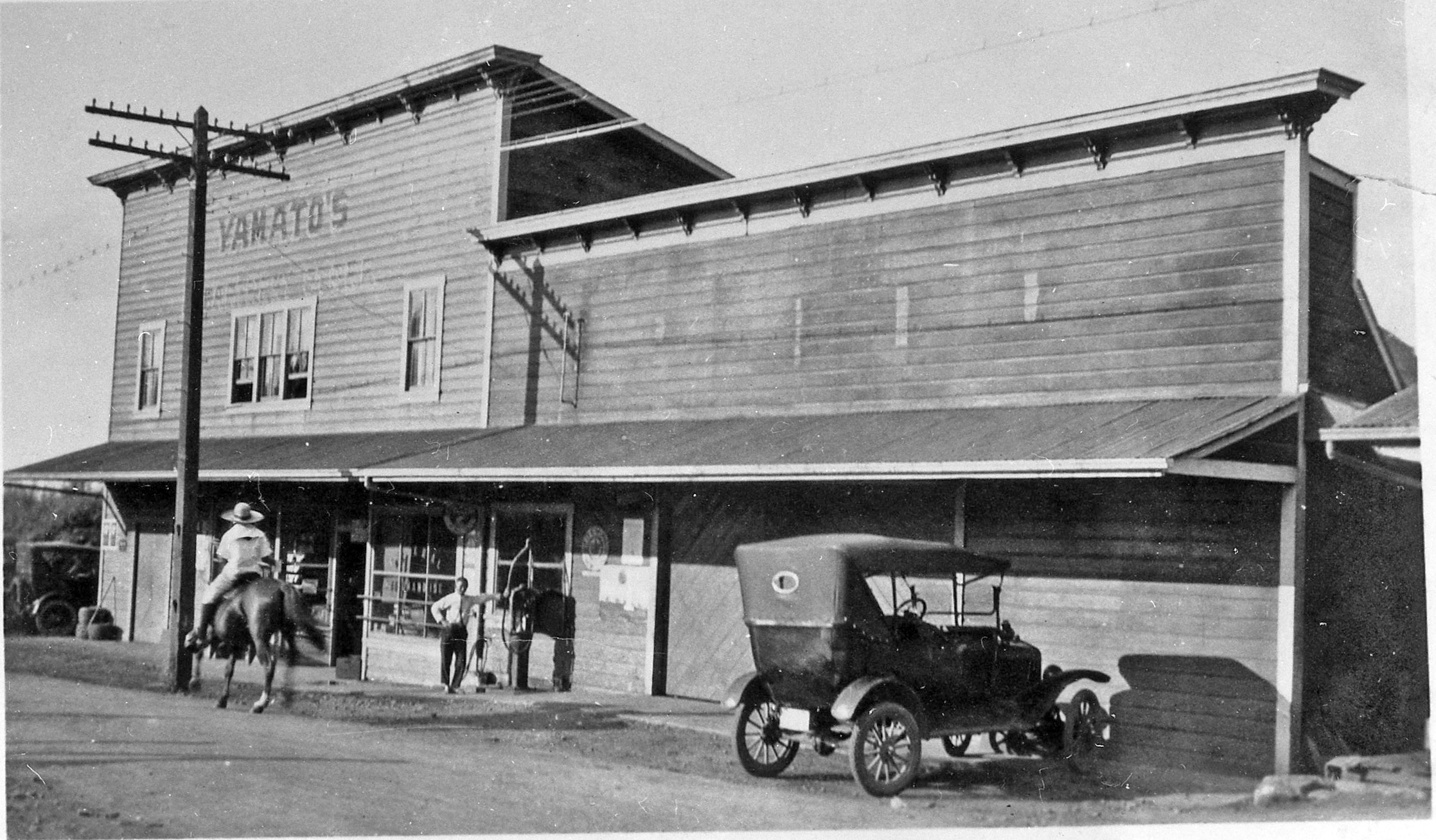
1920 “Yamato Store and the adjacent Yamato Garage were established as family enterprises in uptown Honokaa (across from the Rickard Hotel) in 1920.” Quentin Tomich – Hāmākua Times April 2001
1920s B.U. Yurimitsu had a garage adjacent to Yamasuka Store (across from S. Hasegawa). “I am told that the building had actually been the first theater in town and E.K. Fernandez of Honolulu put on traveling Vaudeville shows there”
1920s Sometime in the 1920s Lawson’s Store became Awong Store (now the Credit Union) Char and Char pg. 83
1921 “New Film Theater at Honokaa Nearly Ready” [possibly Doc Hill Theater?] Hilo Daily Tribune March 11, 1921
1921 Honokaa Theater to be Open Soon” “The new motion picture house at Honokaa will open for business in the near future. The building which is located opposite the Honokaa Club is almost finished and there remains but the painting to be done and a few other details to be attended to.” Hilo Daily Tribune April 8, 1921
1921 “Electric Lights Aim of Honokaa” “Honokaa seems destine to become a very important town when the railroad is extended to it, and beyond to Waimea and Kawaihae.” Hilo Daily Tribune March 4, 1921
1921 to 1927 The post office was at the Botelho Garage – History of the Honokaa Post Office by William Botelho and Thelma Olival
1922 “Honokaa Village Begins to Assume Metropolitan Airs” “Hope to have water system installed this year. Water will be obtained from Hawaiian Irrigation company; Purification Plant is contemplated.” Hilo Daily Tribune January 10, 1922
1922 Botelho [M.S.] Reports Unusual Success with Radiophone” Hilo Daily Tribune June 18, 1922
1922 “Honokaa to have fine Water System in next few Months” Hilo Daily Tribune October 22, 1922
1924 “Honokaa Golf Club now organized with course in shape” (lists W.G. Lawson as newly elected president and mentions that fees may be paid to the Golf Club at Lawson’s Store) “The links are situated at Honokaa on the Payne property and occupy an area of over 10 acres.” Hilo Tribune Herald Feb. 16, 1924
1924 “Honokaa to have New Movie House with Armory The Honokaa Plantation company has applied for a permit to make alterations to their movie picture house near the mill intending to have extensive work done so as to accommodate the new National Guard company in the same building.” Hilo Tribune Herald May 2, 1924
1924 Honokaʻa School moves to present site on Māmane Street
1927 The post office was moved to the Botelho Building
1927 Botelho building built – Tomich notes
1927 “Honokaʻa Church to be Dedicated” The church is called Honokaʻa New Union Church (Perhaps now the Methodist) – No exact date of published on the article
1927 Bank of Hawaiʻi building built – Tomich notes
1927 “Honokaʻa to have New Bank Building” During construction business will be carried on in Old Honokaʻa Club. Says the present structure has been in use since 1910. Hilo Tribune Herald – August 19, 1927
1927 “New Garage to be Built at Honokaʻa” Describes a two-story garage to be built by M.S. Botelho “On the first floor will be the main store, a show-room, one store room, and office for the manager, a room for the post office department, and a private office for the postmaster. The repair shop and store-room will be adjacent to the main store room on the first floor. On the upper floor will be located a social hall 34 X 60 feet, with a kitchenette opening off. The hall can be used for dances or meeting purposes. There will be six large office rooms on the second floor…” Newspaper and exact date of article not known
1927 “Honokaʻa Building Activity Increases” Speaks of the completion of the new auditorium at Honokaʻa School. “Other construction work now underway in Honokaʻa includes the new home for Bank of Hawaii, the Honokaa Garage, on which work has just started, and the Botelho Garage, now near completion.” Hilo Tribune Herald, November 21, 1927
1927 “Honokaa-Kukuihaele Road Completed” “…a three and one half mile stretch of paved highway, built at a cost of approximately $100,000 stands completed today ready for the inspection of County Engineer E.L. Wung.” Hilo Tribune Herald November 21, 1927
1927 Methodist Church (see above on New Union Church) built – Tomich notes
Late 1920s Alfred Awong rented the store (now Credit Union) from Lawson and later purchased it – Olival article, October 18, 1973
1930 People’s Theater (Tanimoto) built – Tomich notes
1933 Ferreira Building rebuilt – Tomich notes
1935 (circa) Dr. Okada opens his hospital just off Māmane Street
1935 Roman Catholic Church rebuilt – Tomich notes
1935 From journal of the wife of Rev. Preston minister of Union Church – States that there were 3 hotels in Honokaʻa “one run by a haole family [Rickards]. The other two hotels were run by Japanese.” (NHERC Heritage Center files – Journal of Mrs. Preston 1935-1940)
1935 “Henry Nakamura’s mother ran one of the two Japanese hotels in the village” Journal of Mrs. Preston (see above)
1935 “Most of the stores in the village were run by Japanese and they had a unique way of pricing things…one price for Japanese and another for the haole…the latter much higher of course.” Mrs. Preston’s journal (see above)
1936 T. Yamasuka Building built – Tomich notes
Circa 1938 Paradise Restaurant opened by Tomisei Kaneshiro – Long Soup Corner is named after their saimin (so was in the Ferreira building) Hawaii Tribune Herald January 1, 1989 by Arlene Stephl According to Misaoa Kuwaye Sakamoto in 1942 the Kaneshiro supermarket and restaurant was next to the HELCO office (Tribune Herald June 15, 1986)
1939 Honokaʻa Theater (aka Doc Hill Theater) is built (on the Waipiʻo side of Māmane. just past the Credit Union building) and closed sometime in the 1950s – Tomich Perspective son Hāmākua
1940s Business names were “Castillo Music Store, next to him was Virginia’s Gift Shop owned by Felix Torres. Next to them is the George D. Souza liquor place, then the Ando Barber Shop, the Manuel Cantorna, tailor, then Aloha Meat Market owned by John D. Souza, thenMori, photographer, Galinator Billiard, Mako Yoshikami’s Sport Center, then the Yoshikami’s Honokaʻa Bakery and next door the Halo Nanea café” West Hawaiʻi News, September 17, 1952 by Thelma Olival
1941 “During Wolrd War II Nora [Rickard] entertained many a homesick G.I. at the gracious Rickard estate.” From Trial of a Queen: 1895 Military Tribunal
1944 Nora Rickard dies in Honjokaʻa at the of 96
1948 The Kaneshiro brothers (Tomisei and Tomimasa) opened their first grocery store
1951 New Honokaʻa Hongwanji building dedicated (Dr. Okada photo of the event)
1952 Thelma Olival names the blocks in Honokaʻa town – “The Irie block, the Nakamura Hotel, Andrade block, the Holmes block, Enoka block, Hasegawa building, John Jesus building, Takata building, Hamakua Shokai, Botelho block, Ikeuchi building, Andrade block, Awong brothers, Kuramitsu, Yamasuka, Honokaa ?Club, the Yamato and Ujiki block, Harris Laundry, Tanimoto theater, Nakashima and Fujino buildingsthe Okada hospital” – West Hawaii News, September 17, 1952 by Thelma Olival
1956 Dr. Okada closes his hospital and starts to work for the Hāmākua Infirmary
1956 Adjacent to Bank of Hawaiʻi Tom “Racehorse” Onomura and George Vierra built a service station. Bob Tanoue (of Kūkaiʻau) had annual leases on the station for about seven years. Ted Alip took up the lease in 1981 calling thew station “Ted’s Garage.” – Tomich Perspectives on Hāmākua pg. 109
1968 The Credit Union purchases the Awong Store (Char and Char pg. 84)
1969 Tex Drive In opened by Ernest Texeira (site was across the street from the current Tex’s in the laundromat building( Hawaii Island Journal April 16-30, 2002
1972 Jimmy Rice’s antique business opened – Hawaii Tribune Herald January 1, 1989 by Arlene Stephl
1973 Businesses listed in Honokaʻa: Janie George stain glass window maker’s shop, G.K. Distributors discount store, Ilocandias Filipino gift shop (also handling airline reservations), Honokaʻa Chop Suey, Jon’s Snack Shop; Pioneer Federal, Big Island Accounting, and opening this month (December 1973) a Mexican Import gift shop – Hilo Tribune Herald Thelma Olival, December 6, 1973
To learn more about the fascinating history of Honoka’a, please visit the Honoka’a Heritage Center at 45-3490 Māmane St., Suite C or at https://honokaaheritagecenter.org/